

Cloud Retail Market Expands Rapidly with Rising AI and E-Commerce Adoption
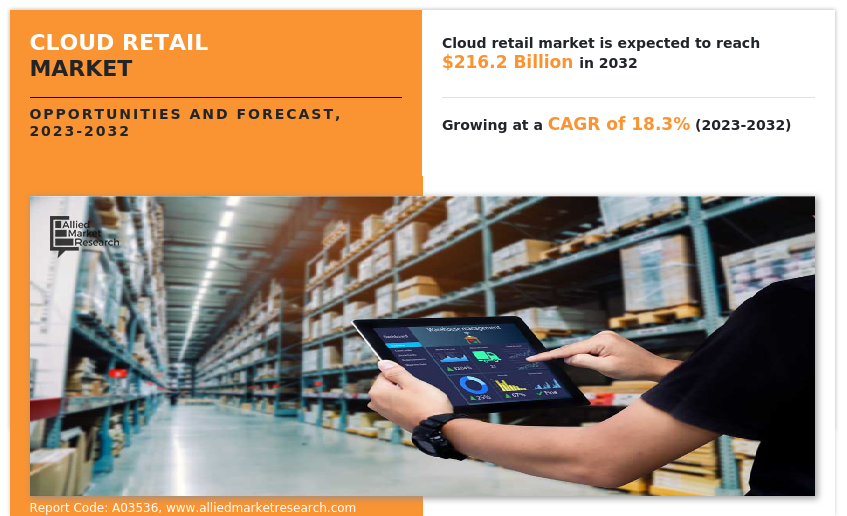
Global cloud retail market is projected to reach $216.2 billion by 2032 driven by AI, SaaS, and e-commerce growth.
Cloud Retail Market Expected to Reach $216.2 Billion by 2032 as Retailers Accelerate Digital Transformation”
WILMINGTON, DE, UNITED STATES, May 27, 2026 /EINPresswire.com/ -- — Allied Market Research
The global cloud retail market is witnessing significant growth as retailers worldwide increasingly adopt cloud-based technologies to improve customer experiences, optimize operations, and strengthen digital capabilities. According to a recent report published by Allied Market Research, the cloud retail market size was valued at $40.8 billion in 2022 and is projected to reach $216.2 billion by 2032, registering a CAGR of 18.3% from 2023 to 2032.
The rapid expansion of e-commerce platforms, rising demand for omni-channel retailing, and growing adoption of advanced technologies such as artificial intelligence, machine learning, and cloud computing are among the key factors driving the cloud retail market globally. Retailers are increasingly shifting from traditional infrastructure to cloud-enabled systems to gain real-time business insights, improve operational flexibility, and offer personalized customer experiences.
Download PDF Brochure: https://www.alliedmarketresearch.com/request-sample/3879
Overview of the Cloud Retail Market
Cloud retail refers to the use of cloud computing technologies within the retail industry to manage operations, customer interactions, supply chains, workforce activities, and digital commerce platforms. Cloud-based retail solutions provide businesses with scalable and flexible systems that can be accessed remotely from any location.
The cloud retail market is expanding rapidly because cloud platforms help retailers streamline operations, reduce infrastructure costs, and improve customer engagement. Retailers can use cloud-based systems to manage inventory, monitor customer behavior, analyze sales trends, and optimize marketing strategies.
Cloud retail technologies also support real-time access to business data, enabling organizations to make faster and more informed decisions. As competition intensifies in the retail sector, businesses are increasingly relying on cloud solutions to improve efficiency and maintain customer loyalty.
Rising Adoption of Omni-Channel Retail Driving Market Growth
The increasing popularity of omni-channel retail strategies is a major factor fueling the cloud retail market. Modern consumers expect seamless shopping experiences across online stores, mobile applications, social commerce platforms, and physical retail outlets.
Cloud retail platforms enable businesses to integrate multiple sales channels into a unified system, allowing customers to interact with brands consistently across different touchpoints. Retailers can synchronize customer data, inventory information, and promotional campaigns in real time.
The growing demand for personalized shopping experiences is encouraging retailers to invest in advanced cloud retail solutions capable of analyzing customer preferences and purchasing patterns. These insights help retailers deliver targeted promotions, customized product recommendations, and loyalty rewards programs.
As consumer expectations continue evolving, omni-channel capabilities are expected to remain a critical driver of the cloud retail market throughout the forecast period.
Cloud Technology Transforming Retail Operations
Cloud computing is revolutionizing retail operations by providing businesses with scalable, flexible, and cost-effective digital infrastructure. Retailers are increasingly adopting cloud-based systems for workforce management, inventory tracking, customer relationship management, supply chain optimization, and data security.
One of the key advantages of cloud retail solutions is the ability to gather and analyze data from multiple sources. Retailers can gain a comprehensive view of customer interactions across online and offline channels, helping them better understand purchasing behavior and market trends.
Cloud technology also simplifies operational management by automating routine tasks, reducing manual errors, and improving workflow efficiency. Businesses can quickly scale cloud resources according to changing customer demand without investing heavily in physical infrastructure.
The growing need for operational agility and business continuity is expected to further strengthen the adoption of cloud retail technologies worldwide.
Artificial Intelligence and Data Analytics Enhancing Retail Experiences
Artificial intelligence (AI) and machine learning technologies are playing a transformative role in the cloud retail market. Retailers are increasingly using AI-powered cloud platforms to improve customer engagement, automate operations, and enhance inventory management.
AI-driven analytics help retailers understand customer purchasing habits, brand preferences, and shopping trends. This information allows businesses to create personalized marketing campaigns and offer targeted product recommendations.
Machine learning algorithms can also optimize inventory planning by forecasting customer demand and identifying purchasing patterns. These capabilities help retailers minimize stock shortages and reduce excess inventory costs.
Cloud-based AI solutions are further improving digital shopping experiences through personalized search functions, intelligent recommendation engines, and automated customer support systems.
As retailers continue investing in AI-powered cloud technologies, the cloud retail market is expected to witness substantial innovation and expansion in the coming years.
E-Commerce Expansion Fueling the Cloud Retail Market
The rapid growth of e-commerce platforms is significantly accelerating demand for cloud retail solutions. Online retailers require scalable infrastructure capable of handling large transaction volumes, customer interactions, and digital marketing operations.
Cloud-based e-commerce platforms allow businesses to quickly launch online stores, manage inventory in real time, and support secure payment processing. These systems provide the flexibility needed to adapt to changing market conditions and consumer preferences.
The increasing use of smartphones and mobile commerce applications has further strengthened the importance of cloud-enabled retail ecosystems. Consumers now expect fast, convenient, and personalized online shopping experiences, encouraging retailers to invest in advanced digital infrastructure.
Global e-commerce leaders are also driving the adoption of cloud technologies by continuously expanding their digital retail capabilities and enhancing customer experiences.
Supply Chain Management Segment Dominates the Market
Based on solution type, the supply chain management segment accounted for the largest share of the cloud retail market in 2022. Efficient supply chain operations are essential for retailers seeking to meet customer expectations and maintain inventory accuracy.
Cloud-based supply chain management solutions provide real-time visibility into sourcing, warehousing, transportation, and product delivery processes. Retailers can monitor inventory levels, track shipments, and identify supply chain disruptions more effectively.
The ability to access real-time operational data helps retailers improve decision-making and reduce delivery delays. Advanced analytics and predictive tools also enable businesses to optimize procurement strategies and demand forecasting.
As retailers continue focusing on operational efficiency and customer satisfaction, cloud-enabled supply chain management systems are expected to remain a major growth segment within the cloud retail market.
Procure This Report (309 Pages PDF with Insights, Charts, Tables, and Figures): https://www.alliedmarketresearch.com/cloud-retail-market/purchase-options
Public Cloud Deployment Leading Adoption
By deployment model, the public cloud segment generated the highest revenue in the cloud retail market in 2022. Public cloud solutions are widely preferred due to their scalability, affordability, and ease of implementation.
Retailers adopting public cloud infrastructure can reduce hardware investments while benefiting from flexible computing resources and remote accessibility. Public cloud platforms also support rapid software updates and improved collaboration across business units.
The growing demand for cloud-native retail applications and software-as-a-service (SaaS) solutions is contributing to the dominance of public cloud deployment models.
Many retailers are increasingly adopting hybrid and multi-cloud strategies to improve operational resilience and enhance digital transformation initiatives.
Software-as-a-Service Segment Expanding Rapidly
Based on service model, the software-as-a-service (SaaS) segment led the cloud retail market in 2022. SaaS solutions provide retailers with subscription-based access to cloud applications without requiring extensive IT infrastructure.
Retailers are increasingly adopting SaaS platforms for customer relationship management, inventory management, workforce scheduling, and digital commerce operations. SaaS solutions offer lower implementation costs, faster deployment, and simplified maintenance.
The flexibility and scalability of SaaS platforms make them particularly attractive for retailers seeking to adapt quickly to changing consumer trends and business requirements.
As digital transformation initiatives continue accelerating across the retail industry, SaaS adoption is expected to remain a major contributor to cloud retail market growth.
Large Enterprises Hold Significant Market Share
By enterprise size, the large enterprises segment dominated the cloud retail market in 2022. Large retailers are heavily investing in advanced cloud technologies to manage extensive customer databases, multi-channel operations, and global supply chains.
These organizations require scalable cloud infrastructure capable of supporting high transaction volumes, real-time analytics, and personalized customer engagement strategies.
Large enterprises are also leveraging cloud platforms to integrate artificial intelligence, automation, and predictive analytics into retail operations. These technologies help businesses improve operational efficiency and enhance customer satisfaction.
However, small and medium-sized enterprises are increasingly adopting cloud retail solutions due to the growing availability of affordable and flexible cloud-based services.
North America Dominates the Cloud Retail Market
North America accounted for the largest share of the cloud retail market in 2022. The region has a highly developed digital retail ecosystem supported by strong technology infrastructure and widespread adoption of cloud computing.
Retailers in the United States and Canada are increasingly investing in cloud-based platforms to improve customer engagement, streamline supply chain operations, and strengthen e-commerce capabilities.
The rapid growth of online shopping and mobile commerce has further accelerated cloud adoption across the North American retail sector. Major technology companies and e-commerce leaders are continuously introducing innovative cloud solutions to support retail transformation.
Additionally, increasing investments in artificial intelligence, analytics, and automation technologies are expected to sustain market growth in the region.
Asia-Pacific Emerging as a High-Growth Region
Asia-Pacific is expected to witness substantial growth in the cloud retail market during the forecast period. Countries such as China, India, Japan, and South Korea are experiencing rapid digitalization and increasing internet penetration.
The growth of e-commerce platforms, mobile payment systems, and smartphone adoption is creating strong demand for cloud-based retail solutions across the region.
Retailers in Asia-Pacific are increasingly embracing cloud technologies to improve inventory management, customer engagement, and operational efficiency. Government initiatives supporting digital transformation and smart retail development are also contributing to market expansion.
The growing middle-class population and rising consumer spending are expected to create additional opportunities for cloud retail providers in Asia-Pacific.
COVID-19 Pandemic Accelerated Cloud Retail Adoption
The COVID-19 pandemic significantly accelerated the adoption of cloud retail technologies worldwide. During lockdowns and social distancing restrictions, retailers rapidly shifted toward digital commerce and online customer engagement.
Cloud-based e-commerce platforms enabled retailers to maintain business operations, manage online transactions, and deliver personalized shopping experiences despite physical store closures.
The pandemic also highlighted the importance of supply chain visibility, digital payment systems, and real-time customer analytics. Retailers increasingly adopted cloud solutions to optimize inventory management and improve operational flexibility.
However, changing consumer behavior during the pandemic created challenges for retailers attempting to forecast demand and personalize shopping experiences accurately.
Despite these challenges, the long-term outlook for the cloud retail market remains highly positive as businesses continue prioritizing digital transformation initiatives.
Strategic Initiatives by Leading Companies
Major companies operating in the cloud retail market are actively pursuing partnerships, product innovation, and AI integration strategies to strengthen their market position.
In June 2021, Oracle partnered with sports retailer Wiggle to migrate its retail operations to Oracle cloud infrastructure and merchandising cloud services. This collaboration helped Wiggle improve demand forecasting, reduce operational costs, and accelerate business growth.
In January 2023, Google introduced advanced AI tools for e-commerce personalization, product recommendations, and inventory management. These innovations were designed to improve customer experiences and support retailers with digital merchandising strategies.
Other key companies operating in the cloud retail market include SAP, Fujitsu, Amazon Web Services, Cisco, IBM, Microsoft, Infor, and Epicor.
Get a Customized Research Report: https://www.alliedmarketresearch.com/request-for-customization/3879
Future Outlook of the Cloud Retail Market
The future of the cloud retail market appears highly promising as retailers continue embracing digital technologies to meet evolving consumer expectations. The growing adoption of omni-channel strategies, AI-driven analytics, and cloud-based infrastructure is expected to drive sustained market expansion over the next decade.
Retailers are increasingly prioritizing customer personalization, supply chain optimization, and operational agility to remain competitive in a rapidly changing marketplace. Cloud retail technologies will continue playing a crucial role in enabling these capabilities.
Furthermore, advancements in artificial intelligence, machine learning, automation, and data analytics are expected to further enhance the efficiency and scalability of cloud retail solutions.
As the global retail industry becomes increasingly digital and customer-centric, the cloud retail market is expected to remain a vital component of the future retail ecosystem through 2032 and beyond.
Trending Reports in Energy and Power Industry:
Cloud Retail Market
https://www.alliedmarketresearch.com/cloud-retail-market
Industrial Cloud Market
https://www.alliedmarketresearch.com/industrial-cloud-market
Cloud Security Posture Management Market
https://www.alliedmarketresearch.com/cloud-security-posture-management-market-A31310
Distributed Cloud Market
https://www.alliedmarketresearch.com/distributed-cloud-market-A09543
Cloud Managed Services Market
https://www.alliedmarketresearch.com/cloud-managed-services-market
Indonesia Over-The-Top (OTT) Market
https://www.alliedmarketresearch.com/indonesia-over-the-top-market
Geospatial Analytics Market
https://www.alliedmarketresearch.com/geospatial-analytics-market
Enterprise Agile Transformation Services Market
https://www.alliedmarketresearch.com/enterprise-agile-transformation-services-market
Risk management market
https://www.alliedmarketresearch.com/risk-management-software-market
About Us
Allied Market Research (AMR) is a full-service market research and business-consulting wing of Allied Analytics LLP based in Portland, Oregon. Allied Market Research provides global enterprises as well as medium and small businesses with unmatched quality of "Market Research Reports" and "Business Intelligence Solutions." AMR has a targeted view to provide business insights and consulting to assist its clients to make strategic business decisions and achieve sustainable growth in their respective market domain.
Pawan Kumar, the CEO of Allied Market Research, is leading the organization toward providing high-quality data and insights. We are in professional corporate relations with various companies and this helps us in digging out market data that helps us generate accurate research data tables and confirms utmost accuracy in our market forecasting. Each and every data presented in the reports published by us is extracted through primary interviews with top officials from leading companies of domain concerned. Our secondary data procurement methodology includes deep online and offline research and discussion with knowledgeable professionals and analysts in the industry.
David Correa
Allied Market Research
+ + + + + + + + + + + + +1 800-792-5285
email us here
Visit us on social media:
LinkedIn
Facebook
YouTube
X
Legal Disclaimer:
EIN Presswire provides this news content "as is" without warranty of any kind. We do not accept any responsibility or liability for the accuracy, content, images, videos, licenses, completeness, legality, or reliability of the information contained in this article. If you have any complaints or copyright issues related to this article, kindly contact the author above.
